 Schedule Your
 Make a payment to Horizon Eye Care
  OnlineStore
 Text for Appointment
  Chat with Us
  Call 704.365.0555

Patient wearing UV protective eyewear
For the first time, ophthalmologists can insert a lens with an adjustable focal point. By slightly manipulating its shape through multiple sessions while you’re wearing it, doctors can fine-tune your vision to get closer to the desired results than ever before. The secret? Ultraviolet light.
Ultraviolet Light and LALs
This may sound odd, as doctors usually warn us to avoid too much UV exposure to the eyes and skin through long periods in the sun. However, LAL lenses have a protective coating that permits UV rays to enter the lens but not come through the back of it to damage the eye.
The LAL is made of a special photosensitive material that changes in response to a Light Delivery Device. This device precisely reshapes your lens, according to the visual correction needed to meet your customized prescription.
How Do LALs Differ from Other Cataract Surgery?
The time leading up to the surgery and the operation itself remain the same. A doctor will put numbing drops in your eye to keep you from feeling anything – most patients stay awake during the event – then use tiny tools to cut into your eye, break up the lens and remove it, and implant the new artificial lens in a space called the lens capsule.
In conventional cataract surgery, you go home to heal and have the second eye done two or three weeks later. But with LAL and LAL+ lenses, the procedure has just begun. Once the eye has healed, the doctor adjusts the shape of the lenses with a Light Delivery Device, usually in one or two sessions. After that comes the lock-in session that permanently secures the desired result.
Your ophthalmologist will probably shorten the time between lens implants in the two eyes with an LAL or LAL+. An important note: During the adjustment period, you must wear UV-protective glasses all day outside and most of the time inside, except for showering and a few other tasks. This prevents the UV rays in sunlight from changing the outcome. After the lock-in session, exposure to sunlight will not affect the lens.
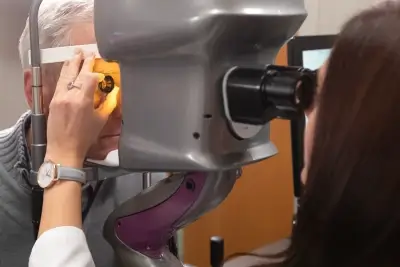
Patient undergoing light treatment
Who’s a Good Candidate for LAL Lenses?
People usually get them because they don’t want to put on glasses again for reading or driving. Remember that the most skilled surgeons and sophisticated technology still have a small margin of error when inserting a traditional monofocal lens, the only kind for which insurance will pay.
LALs have been around for seven years. Not all surgeons have taken up the technique, because the intensive nature of post-operative care limits the number of patients they can see. But more and more patients have decided that extra-crisp vision for decades justifies the expense.
Doctors save the LAL+ for patients who want especially sharp close-up vision and have never had cornea surgery. Patients who have had LASIK or other cornea surgery or treatments for corneal disease can still get LALs. By the way, having an LAL inserted does not prevent you from having work done later to reshape your cornea, the other element of the eye that focuses light.
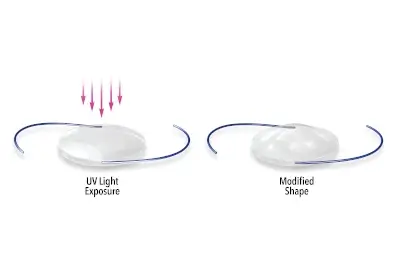
LAL pre-and-post-adjustment
Who Is Not a Candidate for LALs?
- Patients whose pupils do not dilate enough for a UV light treatment to occur in the postoperative period.
- Patients with nystagmus, whose eyes can’t keep still for light adjusting treatments.
- Patients with recurring corneal viral problems such as herpes keratitis, because surgery and/or UV light treatments might reactivate the condition.
- Patients actively taking oral medications that make them sensitive to UV light.
However, patients who have macular degeneration may still be candidates for LALs, as the shield on the artificial lens will block UV light 100 percent.
To schedule a consultation at Horizon Eye Care, call 704-365-0555 Monday-Thursday, 8 a.m. to 5 p.m., or Friday, 8 a.m. to 3 p.m. The optical department closes on Fridays at 2:30 p.m.